


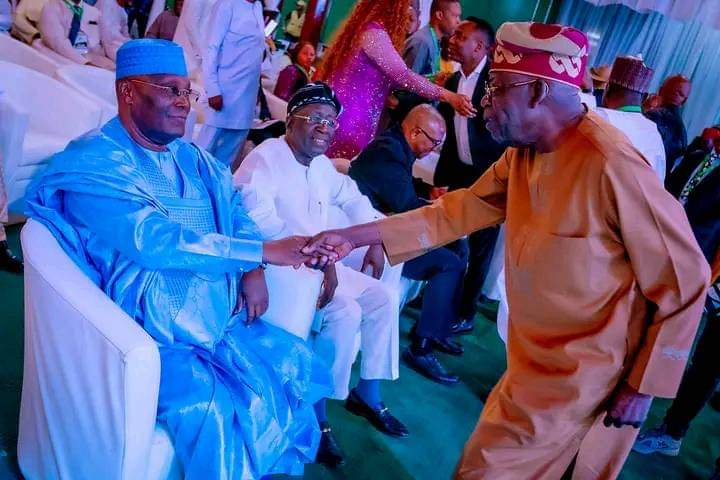
We Can’t Keep Quiet As Tinubu’s Policies Cause Pain, Distress, Tears, Hunger — Atiku
Former Vice President Atiku Abubakar has said that Nigerians cannot keep quiet when the policies of the President Bola Tinubu administration are causing pain and distress to the rest of the country.
In a statement he personally issued on Sunday, the presidential candidate of the Peoples Democratic Party (PDP) in the 2023 election, accused the President of failing to offer any concrete measures to tackle the foreign exchange crisis and rising poverty in a recent meeting he called on the issue.
According to the former vice president, Tinubu rather used the occasion to warn against distraction from “cooking their cocktail” that has continued to cause hardship in the country.
He stated: “At a meeting called at his instance on Thursday to address the Foreign Exchange crisis and the problem of economic downturn, among others, Bola Tinubu failed, yet again, to showcase any concrete policy steps that his administration is taking to contain the crises of currency fluctuation and poverty that face the country.
“Rather, he told the country and experts who have been offering ideas on how to resolve the crisis that he and his team should not be distracted and allowed time to continue cooking their cocktail that has brought untold hardship to the people of Nigeria.
“I don’t agree with that. The wrong policies of the Tinubu administration continue to cause untold pain and distress on the economy and the rest of us cannot keep quiet when, clearly, the government has demonstrated sufficient poverty of ideas to redeem the situation.
“If the government will not hold on to their usual hubris, there are ways that the country can walk out of the current crisis.”
Atiku pointed out that he had assessed the state of the economy and realizing that it was heading in the wrong direction, adding that he came up with a number of policy prescriptions contained in his policy document.
“After a careful assessment of the state of our economy at the twilight of the last administration, I knew full well that the economy of the country was heading for the ditch and came up with a number of policy prescriptions that would rescue the country from getting into the mess that we are currently in.
“Those ideas, encapsulated in my policy document titled: My Covenant With Nigerians made the following prescriptions:
“I had signed on to a commitment to reform the operation of the foreign exchange market. Specifically, there was a commitment to eliminate multiple exchange rate windows. The system only served to enrich opportunists, rent-seekers, middlemen, arbitrageurs, and fraudsters.
“A fixed exchange rate system would be out of the question. First, it would not be in line with our philosophy of running an open, private sector friendly economy.
“Secondly, operating a successful fixed-exchange rate system would require sufficient FX reserves to defend the domestic currency at all times. But as is well known, Nigeria’s major challenge is the persistent FX illiquidity occasioned by limited foreign exchange inflows to the country.
“Without sufficient FX reserves, confidence in the Nigerian economy will remain low, and Naira will remain under pressure. The economy will have no firepower to support its currency. Besides, a fixed-exchange rate system is akin to running a subsidy regime!
“On the other hand, given Nigeria’s underlying economic conditions, adopting a floating exchange rate system would be an overkill. We would have encouraged the Central Bank of Nigeria to adopt a gradualist approach to FX management.
“A managed-floating system would have been a preferred option. In simple terms, in such a system, the Naira may fluctuate daily, but the CBN will step in to control and stabilize its value. Such control will be exercised judiciously and responsibly, especially to curb speculative activities.
“Why control, you may ask.
“Nigeria has insufficient, unstable, and precarious foreign reserves to support a free-floating rate regime. Nigeria’s reserves did not have enough foreign exchange that can be sold freely at fair market prices during crises.
“Nigeria is not earning enough US$ from its sales of crude oil because its production of oil has been declining. and, Nigeria is not attracting foreign investment in appreciable quantities.
“These are enough reasons for Nigeria to seek to have a greater control of the market, at least in the short to medium term when convergence is expected to be achieved.
“Tinubu’s new FX management policy was hurriedly put together without proper plans and consultations with stakeholders. The government failed to anticipate or downplay the potential and real negative consequences of its actions.
“The Government did not allow the CBN the independence to design and implement a sound FX Management Policy that would have dealt with such issues as increasing liquidity, curtailing/regulating demand, dealing with FX backlogs and rate convergence.
“I firmly believe that if and when the Government is ready to open itself to sound counsels, as well as control internal bleedings occasioned by corruption and poorly negotiated foreign loans, the Nigerian economy would begin to find a footing again.”
