Tinubu Administration Enrols 8 Million Nigerians in Health Insurance, Upgrades Over 3,000 PHCs – Salako
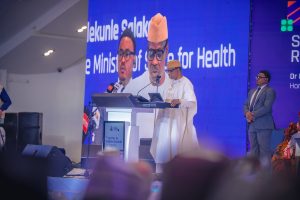
The Federal Government has enrolled nearly eight million additional Nigerians in health insurance, upgraded more than 3,000 Primary Healthcare Centres (PHCs) and increased access to basic healthcare services under President Bola Ahmed Tinubu’s administration.
The Minister of State for Health and Social Welfare, Dr Iziaq Adekunle Salako, disclosed this on Tuesday, November 10, 2026, during the opening ceremony of the 2026 Nigeria Health Sector Joint Annual Review (JAR) in Abuja.
Speaking at the Transcorp Event Centre, Maitama, with the theme, “Make the Data Count,” Salako said the achievements reflected measurable progress under the Health Sector Renewal Investment Initiative and the Renewed Hope Agenda.
He explained that more than three million of the newly enrolled Nigerians in the health insurance scheme belong to vulnerable groups, while the government is directly supporting over 8,000 PHCs across the country.
According to him, the utilisation of primary healthcare facilities has more than doubled, while over N290 billion has been delivered for basic healthcare services.
The minister further disclosed that more than 3,000 PHCs had been upgraded to Level 2 readiness, adding that facility-reported maternal deaths had declined by approximately 60 per cent compared with 2024.
He also said facility-reported neonatal and under-five deaths had reduced by 22 per cent and 25 per cent, respectively.
On local pharmaceutical production, Salako said data from the Pharmaceutical Group of the Manufacturers Association of Nigeria and the National Agency for Food and Drug Administration and Control (NAFDAC) showed an approximately 10 per cent increase in active local pharmaceutical companies.
He added that the share of locally manufactured pharmaceutical products had increased from 30 per cent in 2023 to 50 per cent in 2026.
The minister said the administration had made substantial progress in implementing the eight-point health priorities of the Renewed Hope Agenda, with key performance indicators recording between 60 and 92 per cent across various programme areas.
He listed the areas to include governance, health security, local production, health financing, primary and secondary healthcare, workforce development, mental health, equity, quality and preventive care.
Salako described the Joint Annual Review as an accountability platform for assessing performance, identifying implementation gaps and developing actionable resolutions across the country’s health sector.
He noted that the Health Sector Renewal Compact, introduced three years ago, had harmonised previously fragmented health plans under a unified framework of one plan, one budget, one report and one accountability system.
According to him, the 2026 review is particularly significant as it provides an opportunity to assess progress after 42 months of the Tinubu administration and 35 months of implementing the health sector compact.
He said all states and the Federal Capital Territory conducted their respective annual reviews this year, bringing healthcare accountability closer to communities.
The minister also highlighted the importance of the Digital Health Information System 2 (DHIS2) in establishing a reliable source of health data to guide planning, resource allocation and service delivery.
He urged participants to ensure that resolutions reached at the review were assigned to responsible ministries, departments, agencies and development partners, with clear timelines for implementation.
Looking ahead, Salako said the government was working towards achieving 90 per cent functional PHCs by 2031, providing direct quarterly financing to at least 17,600 PHCs through the Basic Healthcare Provision Fund and enrolling 40 per cent of Nigerians in health insurance.
Other targets include extending the Maternal and Neonatal Mortality Reduction Innovation Initiative (MAMII) to all 774 local government areas and reducing out-of-pocket healthcare expenditure to below 50 per cent.
He stressed that the health sector must move beyond counting activities to measuring actual results and improvements in people’s lives.
Salako commended the Coordinating Minister of Health and Social Welfare, Permanent Secretary, directors, heads of agencies, state governments, development partners, traditional and religious leaders and healthcare workers for their contributions to the ongoing reforms.
He called for sustained commitment to ensuring that every naira spent on healthcare translates into lives saved and improved access to quality medical services.