


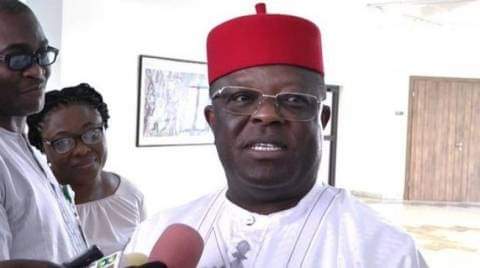
Umahi: FG’s Road Investments to Unlock Economic Opportunities Across Nigeria
The Federal Government’s massive investments in roads and other transport infrastructure are designed to unlock economic opportunities, strengthen national integration and support sustainable growth across Nigeria, the Minister of Works, Engr. David Umahi, has said.
Umahi made the declaration on Wednesday, October 7, 2026, during a press conference in Abuja, where he reviewed the progress of major projects being executed by the President Bola Ahmed Tinubu administration.
He said the government’s four legacy road projects were conceived as strategic infrastructure corridors rather than ordinary road construction projects.
The projects, according to him, are the Lagos-Calabar Coastal Highway, Sokoto-Badagry Superhighway, Calabar-Ebonyi-Abuja Highway, known as the Trans-Saharan Route, and the Akwanga-Jos-Bauchi-Gombe-Biu-Maiduguri Road.
Umahi said the projects would connect the six geopolitical zones, improve the movement of goods and people and create opportunities for agriculture, industry, tourism, trade and investment.
Providing an update on the Lagos-Calabar Coastal Highway, the Minister said the first 47-kilometre section had been completed, while work on the approximately 55-kilometre second section was nearing completion.
He said major flyovers, overpasses and underpasses were being constructed along the corridor to overcome traffic and engineering challenges.
According to him, some portions of the highway had to be redesigned to accommodate existing and proposed infrastructure around the Dangote Refinery and Lekki Deep Seaport.
He said the redesign was aimed at creating an integrated transportation network involving road, rail and industrial infrastructure.
The Minister also explained that difficult terrain, deep pits and challenging subsoil conditions necessitated redesigns along some portions of the Ondo axis.
He said ground improvement and substantial filling works were being carried out to guarantee the long-term durability and safety of the road.
Umahi disclosed that President Tinubu had also directed that the continuation of the Lagos-Calabar Coastal Highway be aligned with the existing East-West Road in parts of the Niger Delta.
He said the decision was aimed at addressing flooding and climate-related challenges, noting that vulnerable portions of the East-West Road would be raised to accommodate present and future flood levels.
The Minister also cited the Benin City Bypass and other sections of the littoral corridor as important interventions that would reduce congestion and improve transportation across the South-South.
On the Sokoto-Badagry Superhighway, Umahi said the project would link Ilelah in Sokoto State with Badagry in Lagos, creating a major economic corridor across the country.
He said construction was progressing on various sections, particularly across the Sokoto, Kebbi, Oyo, Ogun and Badagry axes, while sections in Niger and Kwara states were expected to commence soon.
Beyond transportation, he said the corridor would stimulate agriculture, housing, tourism, industry and other economic activities.
On the Trans-Saharan Route, the Minister said the project would provide stronger links between the coastal regions and northern Nigeria while improving the movement of goods and services across the South-South, South-East and North-Central regions.
He said additional sections had been approved after substantial progress on the initial components, with the aim of making the corridor more economically attractive to investors and financiers.
For the Akwanga-Jos-Bauchi-Gombe-Biu-Maiduguri Road, Umahi said the Federal Government was expanding the existing single carriageway and had extended the project to include a Jos-Ibi spur in Taraba State.
He said design and procurement activities for the additional component were ongoing.
The Minister also announced progress on several other federal road projects, listing the Kwanar Danja-Hadejia Road, Kaduna-Pambeguwa Road, Lafia Bypass, Bodo-Bonny Road and bridges along the Opobo Channel among completed or commissioning-ready projects.
Other projects he mentioned included the Gombe-Potiskum rehabilitation, sections of the Azare road linking Jigawa and Bauchi, the five-span Ampoha Bridge, the Ekpoma-Benin 23-kilometre, 23-span flyover project and a three-span, 75-metre dualised bridge.
Umahi said several sections of the Lagos-Badagry, Lagos-Ibadan and Lagos-Shagamu-Ore corridors had also been completed, while work continued on outstanding sections.
He said the Ministry was updating its compendium of completed and ongoing projects and would make it available to the public through its website.
The Minister also defended the adoption of concrete pavement on major highways, saying it was intended to provide longer-lasting infrastructure and reduce recurring maintenance costs.
He explained that the procurement process for the Lagos-Calabar Coastal Highway followed the applicable framework, noting that the special approach was necessitated by the complex coastal engineering requirements of the project.
According to him, the Ministry recommended a contractor with relevant experience to the Bureau of Public Procurement, which reviewed and cleared the recommendation, while the Federal Executive Council retained final approval authority.
He said proposed contract rates were benchmarked against prevailing market prices and that all contractors were subjected to the same evaluation principles.
On the Abuja-Kaduna-Zaria-Kano Expressway, Umahi said all outstanding sections had been completed except the Jere-Kaduna portion, which he said was progressing.
He disclosed that solar-powered lighting was being installed along the 375-kilometre corridor to improve visibility and enhance safety and security.
The Minister also announced the commencement of “Operation Rescue” on the Benin-Asaba Expressway, saying the intervention followed challenges associated with the road and its concession arrangement.
He said the Federal Government was restoring mobility on the road while planning a comprehensive reconstruction using continuously reinforced concrete pavement.
Umahi further highlighted the administration’s infrastructure interventions in the South-East, citing the Second Niger Bridge, rehabilitation of the First Niger Bridge, bypass projects and other federal road investments.
He said the South-East was being reintegrated into the national infrastructure development plan, stressing that infrastructure delivery should be driven by national integration rather than regional considerations.
The Minister warned contractors who had collected mobilisation or project funds but failed to deploy them to site that the Ministry would take steps to recover the funds.
He said accountability, performance and value for money remained central to the Federal Government’s infrastructure programme.
On the First Niger Bridge, Umahi said the Ministry was implementing traffic management measures, CCTV surveillance and other security interventions at the Asaba and Onitsha ends.
He explained that prolonged traffic gridlock could create additional structural challenges because bridges were primarily designed to accommodate dynamic loads.
He said remedial works, repainting and other maintenance activities were also being undertaken.
Umahi said the government’s road development strategy also included environmental interventions such as tree planting and solar-powered street lighting along major highways.
He linked the infrastructure programme to the Renewed Hope Agenda, saying better roads would strengthen agricultural production, industrialisation, commerce, tourism and investment.
On financing, the Minister assured Nigerians that mechanisms were in place to ensure that the legacy projects were funded through completion, including loan-financing arrangements for outstanding components.
“We don’t start what we will not finish. And we will not finish what we have not started,” Umahi said.
He reaffirmed the Ministry’s commitment to completing inherited projects while executing new strategic infrastructure under the Tinubu administration.
According to him, the legacy projects represent long-term investments intended to reshape Nigeria’s economic landscape, strengthen national connectivity and create opportunities for citizens across the country.
