


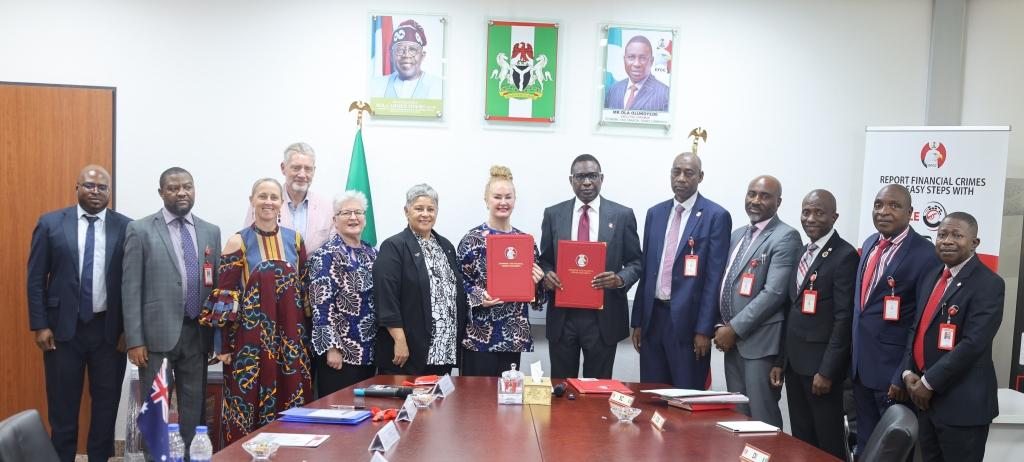
EFCC, Australian Police Sign MoU to Intensify Fight Against Cybercrime
The Economic and Financial Crimes Commission (EFCC) and the Australian Federal Police (AFP) have signed a Memorandum of Understanding (MoU) to strengthen cooperation in combating cybercrime and other transnational financial offences.
The agreement was signed on Wednesday, November 4, 2026, at the EFCC Headquarters in Jabi, Abuja.
Speaking during the signing ceremony, the Australian High Commissioner to Nigeria, Leilani Bin-Juda, commended EFCC Chairman, Ola Olukoyede, and officers of the Commission for maintaining a strong working relationship with the Australian Federal Police over the years.
She noted that both countries had sustained cooperation through the exchange of technology, intelligence and professional expertise, which had strengthened their bilateral relationship.

Bin-Juda described cybercrime as a growing global challenge requiring collective action, adding that Nigeria occupied a significant leadership position in addressing cyber-related threats across Africa.
She said other African countries looked to Nigeria for leadership in tackling cybercrime and commended the EFCC for its efforts.
Also speaking, Assistant Commissioner of the Australian Federal Police, Sandra Booth, described the MoU as a significant milestone in strengthening the existing partnership between the two law enforcement agencies.
She disclosed that cooperation between the EFCC and AFP dated back to 2004 and had yielded positive results in sensitive investigations, cyber-enabled crimes, business email compromise, financial investigations and scams.
Booth expressed optimism that the new agreement would create additional opportunities for collaboration, professional development and the exchange of expertise.
In his remarks, EFCC Chairman, Ola Olukoyede, appreciated the Australian Government and the Australian Federal Police for their continued partnership with the Commission.
He explained that financial crimes had increasingly assumed international dimensions, making cooperation among law enforcement agencies across different countries essential.
According to him, criminals operate through interconnected networks, requiring countries committed to fighting financial crimes to establish equally strong international partnerships.
Olukoyede said the MoU would formalise the longstanding relationship between the two agencies and provide a structured framework for cooperation in training, manpower development, mutual assistance and intelligence sharing.
He added that the exchange of information would be conducted in accordance with the domestic laws of both countries.
The ceremony also featured the presentation of awards by the Australian Federal Police to four EFCC officers in recognition of their exceptional investigative abilities, professionalism and dedication during a complex and lengthy investigation.
The award recipients were Assistant Commander of the EFCC II, Abba Sambo Usman; Assistant Commander of the EFCC II, Olufemi Olukinni; Assistant Commander of the EFCC II, Omewa Pius Nnaemeka; and Inspector of the EFCC I, Owolabi Jude Oyarekhua.
