


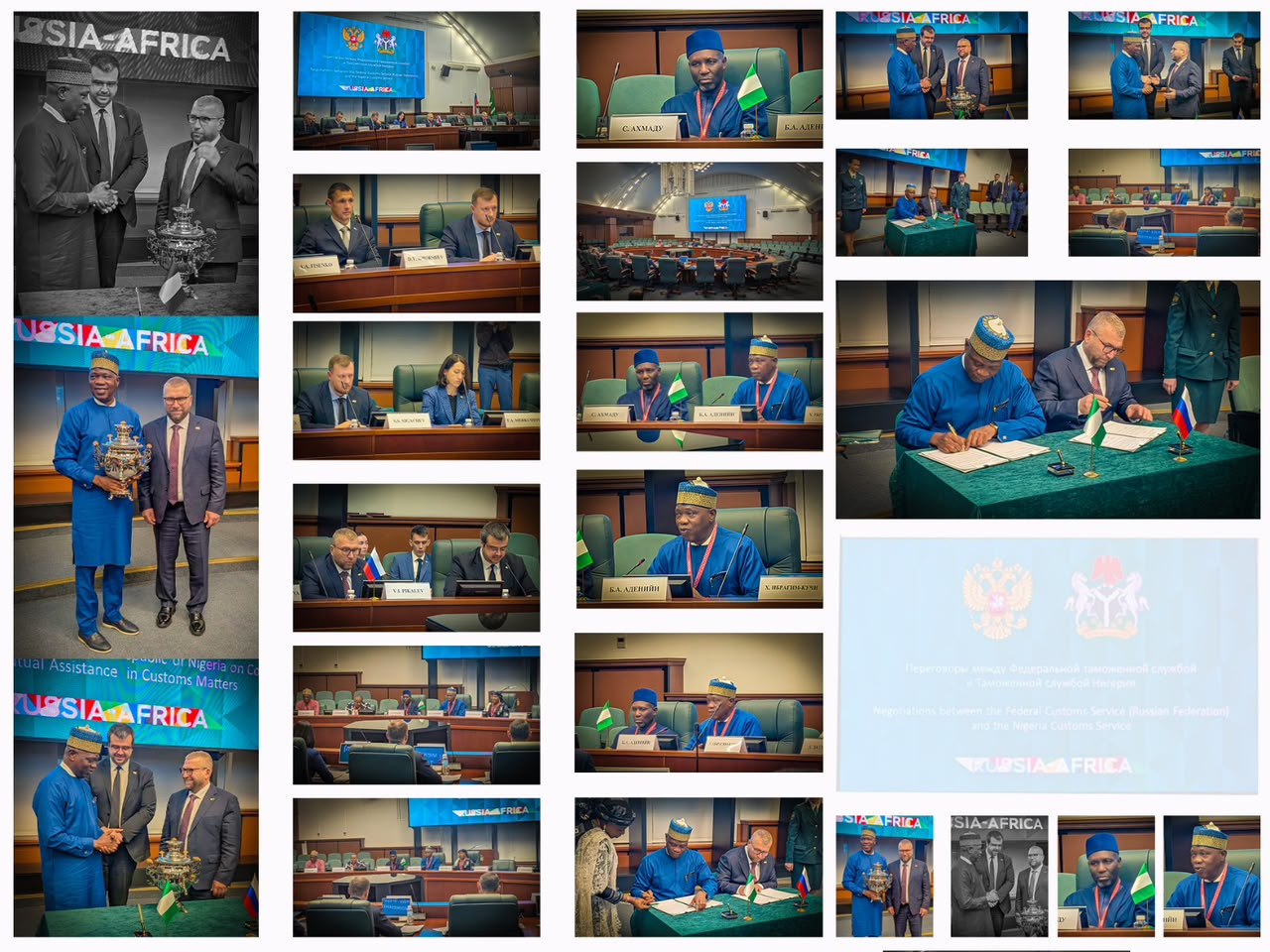
Nigeria, Russia Sign Customs Cooperation Agreement to Boost Trade Facilitation, Intelligence Sharing
…Move to Strengthen Border Security, Mutual Recognition of AEO Programmes
The Nigeria Customs Service (NCS) and the Federal Customs Service of the Russian Federation have signed a landmark agreement aimed at strengthening bilateral cooperation in customs administration, facilitating international trade and improving the exchange of intelligence and trade information.

The Agreement on Cooperation and Mutual Assistance in Customs Matters (CMAA) was signed in Moscow on October 28, 2026, following months of technical consultations, legal reviews and engagements between the two customs administrations.
The Comptroller-General of Customs, Adewale Adeniyi, who led the Nigerian delegation, described the agreement as a strategic framework for protecting economic interests, securing international supply chains and strengthening customs governance.
Adeniyi said the agreement reflects the commitment of both countries to modernising customs operations and addressing emerging challenges in international trade.
He explained that the Nigeria Customs Service had recorded significant progress in its transformation through the implementation of the Nigeria Customs Service Act 2023 and the adoption of digital technologies to automate customs operations.
According to him, the electronic processing of declarations, payments and supporting documents has improved operational efficiency while creating a more favourable environment for legitimate trade.
The Customs boss stressed that revenue generation and trade facilitation could be achieved simultaneously, noting that the Service’s reforms align with the World Customs Organisation’s SAFE Framework of Standards.
On areas of implementation, Adeniyi identified cooperation between the Authorised Economic Operator (AEO) programmes of both countries as a major priority.
He explained that structured exchanges would enable Nigeria and Russia to understand their respective AEO frameworks, operational procedures and implementation experiences, with the ultimate goal of achieving mutual recognition.
Such an arrangement, he noted, would improve confidence in compliant businesses and facilitate faster cargo movement between the two countries.
During discussions with the Head of the Federal Customs Service of Russia, Valery Pikalyov, Adeniyi also highlighted the importance of sharing customs statistics and trade data to strengthen analysis and improve bilateral trade monitoring.
He disclosed that Nigeria was actively participating in the World Customs Organisation’s data initiative, adding that the NCS was the only customs administration to have submitted its trade data to the WCO data project.
Responding, Pikalyov explained that the Russian Customs Service had the statutory responsibility to collect, process and provide customs statistics derived from declarations.
He said Russia already maintained arrangements for exchanging customs statistics with foreign customs administrations, which helped identify trade discrepancies, analyse commercial activities and monitor bilateral trade flows.
Pikalyov expressed the Russian side’s readiness to explore a dedicated data-sharing arrangement with the NCS, subject to relevant procedures and agreements.
The Russian delegation also acknowledged Nigeria as one of the first sub-Saharan African countries, alongside Ethiopia and Namibia, to conclude a customs cooperation agreement with Russia.
The engagement was held within the framework of the Third Russia-Africa Summit, providing an opportunity to strengthen customs collaboration as part of the broader bilateral relationship.
The CMAA covers four major areas: simplification of customs procedures to facilitate legitimate trade; information exchange to prevent and investigate customs offences; financial integrity measures targeting illicit financial flows, tax evasion and grey-market importations; and enhanced border security through joint efforts against counterfeit goods, narcotics, psychotropic substances and other prohibited materials.
The agreement also establishes a legal framework for direct operational assistance, personnel training and the exchange of professional experience between the two customs administrations.
